- Home
- Articles
- Personal finance
- The 50/30/20 budget rule: how it works with real examples
The 50/30/20 budget rule: how it works with real examples
Spend 50% of take-home pay on needs, 30% on wants and 20% on savings and debt. Worked examples in $ and ₹, when to change the split, and a 30-minute setup plan.
On this page
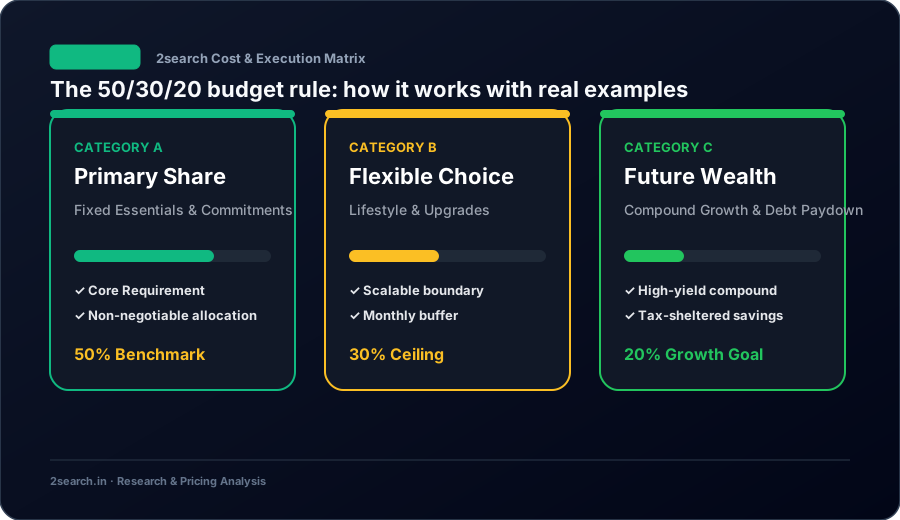
Quick answer: The 50/30/20 rule splits your take-home pay (after tax) into three buckets: 50% for needs (rent, groceries, bills, minimum debt payments), 30% for wants (eating out, shopping, travel, subscriptions) and 20% for savings and extra debt payments. On a $4,000 monthly take-home that's $2,000 / $1,200 / $800; on ₹60,000 it's ₹30,000 / ₹18,000 / ₹12,000. It's a starting point — adjust the split to fit your city, income and goals.
Key takeaways
- Use after-tax income. Count your retirement payroll deductions in the 20%.
- Needs are things you'd still pay if you lost your job. Everything else is a want.
- In expensive cities, 60/20/20 or 70/10/20 may be more realistic.
- The 20% goes in order: emergency fund → high-interest debt → retirement and goals.
- Automate the 20% on payday so you spend what's left, not save what's left.
Budgets fail when they're too complicated. The 50/30/20 rule works because it only asks you to track three numbers. This guide shows exactly what goes in each bucket, works through examples at different incomes, explains when to bend the rule, and gives you a 30-minute way to set it up.
Step 1: Find your monthly take-home pay
Use the amount that actually lands in your bank account each month.
- Salaried: net pay after income tax and social security. If 401(k), EPF or NPS contributions are deducted before you're paid, note them — they count towards your 20%.
- Freelancers / irregular income: average the last 6–12 months, then set aside tax before splitting.
Step 2: Split it into three buckets
| Bucket | Share | What goes in it |
|---|---|---|
| Needs | 50% | Rent or home loan EMI, groceries, electricity, water, gas, phone and internet, insurance, transport to work, child care, minimum loan and card payments |
| Wants | 30% | Eating out, food delivery, entertainment, streaming, shopping, gadgets, gym, holidays, hobbies, upgrades (a nicer car or phone than you need) |
| Savings & debt | 20% | Emergency fund, retirement (401(k), IRA, EPF, PPF, NPS), SIPs, extra debt payments beyond the minimum |
Tip: Not sure if something is a need or a want? Ask: "Would I still pay this if I lost my job tomorrow?" If no, it's a want.
Worked examples
United States
| Monthly take-home | Needs (50%) | Wants (30%) | Savings & debt (20%) |
|---|---|---|---|
| $3,000 | $1,500 | $900 | $600 |
| $4,000 | $2,000 | $1,200 | $800 |
| $6,000 | $3,000 | $1,800 | $1,200 |
| $8,000 | $4,000 | $2,400 | $1,600 |
India
| Monthly take-home | Needs (50%) | Wants (30%) | Savings & investments (20%) |
|---|---|---|---|
| ₹30,000 | ₹15,000 | ₹9,000 | ₹6,000 |
| ₹60,000 | ₹30,000 | ₹18,000 | ₹12,000 |
| ₹1,00,000 | ₹50,000 | ₹30,000 | ₹20,000 |
| ₹2,00,000 | ₹1,00,000 | ₹60,000 | ₹40,000 |
Example: Priya takes home ₹60,000. Rent ₹16,000, groceries ₹7,000, bills ₹3,000, commute ₹2,000 and her phone EMI's minimum ₹2,000 = ₹30,000 needs. She keeps ₹18,000 for wants and sets up a ₹12,000 auto-transfer on payday: ₹5,000 to her emergency fund, ₹5,000 to a SIP and ₹2,000 to PPF.
What to do with the 20% — in order
- Starter emergency fund — one month of expenses (or $1,000 / ₹25,000).
- Pay off high-interest debt — credit cards and personal loans above ~10%.
- Full emergency fund — 3–6 months. See how much you need.
- Retirement — at least enough to get any employer match (US 401(k)), plus EPF/PPF/NPS in India.
- Other goals — house down payment, children's education, investing via SIPs.
When to change the split
The rule is a guide, not a law. Common adjustments:
| Situation | Try this split |
|---|---|
| High-cost city (New York, San Francisco, Mumbai, Bengaluru) | 60/20/20 — less on wants, keep saving |
| Low income where needs take most of the pay | 70/20/10 — then raise savings as income grows |
| High income | 40/30/30 or more savings |
| Paying off heavy debt | 50/20/30 — move wants money to debt for a while |
| Saving for a house in 2–3 years | 50/20/30 temporarily |
If needs are above 60%, look at the biggest items first — housing and transport. A cheaper flat, a flatmate, or a smaller car loan can free up more than cutting coffee ever will.
Set it up in 30 minutes
- Pull last month's bank and card statements.
- Tag each expense as Need, Want or Savings. A spreadsheet or your bank app's categories work.
- Compare with 50/30/20. Where are you over?
- Automate: set a standing instruction or auto-debit for the 20% on payday — to savings, retirement and SIPs.
- Use two accounts: one for needs (bills auto-paid from it) and one for wants (spend freely from this).
- Review monthly for the first three months, then quarterly.
Common mistakes
- Using gross pay instead of take-home — your budget will always feel short.
- Calling wants "needs" — premium phone plans, a bigger car, daily delivery.
- Forgetting yearly costs — insurance, school fees, festivals, gifts. Divide them by 12 and save monthly.
- Saving "what's left" — there's rarely anything left. Pay yourself first.
- Giving up after one bad month. Adjust and keep going.
Is 50/30/20 right for you?
Good fit if you want a simple system, have a steady income and don't want to track every rupee or dollar.
Consider other methods if you have heavy debt or very irregular income. Alternatives include zero-based budgeting (every unit of money gets a job), the envelope method (cash or digital envelopes for each category) and pay-yourself-first (save first, spend the rest freely).
Frequently asked questions
Is the 50/30/20 rule based on gross or net income?
Net (take-home) income. If retirement contributions are taken from your pay before it reaches you, count them in the 20%.
Is rent a need or a want?
A need — but a very expensive home can include a "want" part. If rent alone is over 30–35% of take-home pay, it's worth reviewing.
Do debt payments go in needs or savings?
Minimum payments go in needs. Anything extra you pay to clear debt faster goes in the 20%.
Is 20% savings enough for retirement?
It's a good minimum. Starting late, or wanting to retire early, may need 25–30%.
Does the 50/30/20 rule work in India?
Yes. Many people in big cities use 60/20/20 because rent is high. Count EPF in the savings bucket.
What if I can't save 20%?
Start with any amount — even 5% — and increase it with every raise.
Where did the 50/30/20 rule come from?
It was popularised by US Senator Elizabeth Warren and her daughter in the book "All Your Worth" (2005).