- Home
- Articles
- Personal finance
- How much should be in your emergency fund? A simple way to decide
How much should be in your emergency fund? A simple way to decide
Save 3–6 months of essential expenses — more if your income is uncertain. A 4-step formula, worked examples in $ and ₹, where to keep it and how to build it fast.
On this page
- Step 1: Work out your essential monthly expenses
- Step 2: Choose your number of months
- Step 3: Multiply
- Step 4: Adjust for your safety nets
- Where to keep your emergency fund
- How to build it — even on a tight budget
- Emergency fund vs paying off debt
- What counts as an emergency?
- After you use it
- Review it once a year
- Frequently asked questions
Quick answer: Keep 3 to 6 months of essential expenses — rent or EMI, food, utilities, insurance, transport and minimum debt payments — in an emergency fund. Aim for 6–12 months if you're self-employed, the only earner, or work in a shaky industry. Keep it safe and easy to reach: a high-yield savings account in the US, or a savings account plus a sweep FD or liquid fund in India — not in stocks.
Key takeaways
- Base it on essential expenses, not your salary.
- In the US, only about 63% of adults say they could cover a $400 emergency with cash.
- Build it in stages: one month first, then three, then six.
- It's insurance, not an investment — safety and access beat returns.
- Use it only for real emergencies: job loss, medical bills, urgent repairs.
An emergency fund is the money that stands between a bad week and a debt spiral. Without it, a car repair or a hospital bill goes on a credit card or a high-interest loan. This guide gives you a simple formula to set your number, real examples, the best places to keep it, and a plan to build it — even on a tight budget.
Step 1: Work out your essential monthly expenses
List only what you must pay even if you lost your income:
| Essential | Example (US, monthly) | Example (India, monthly) |
|---|---|---|
| Rent / mortgage / home loan EMI | $1,600 | ₹22,000 |
| Groceries and household items | $500 | ₹9,000 |
| Utilities, phone, internet | $250 | ₹3,500 |
| Insurance premiums (health, term, car) | $300 | ₹3,000 |
| Transport / fuel | $250 | ₹4,000 |
| Minimum loan and card payments | $200 | ₹5,000 |
| Child care / school fees (monthly share) | $0 | ₹6,000 |
| Total essentials | $3,100 | ₹52,500 |
Leave out eating out, subscriptions, shopping, travel and investments — you'd cut those in a real emergency.
Step 2: Choose your number of months
| Your situation | Months to save |
|---|---|
| Stable salaried job, two incomes in the household, good health cover | 3 months |
| Single income, or dependents (children, parents) | 6 months |
| Self-employed, freelancer, commission-based, gig worker | 6–12 months |
| Tech, startups, media or other industries with frequent layoffs | 6–9 months |
| Nearing retirement or with a health condition | 9–12 months |
Step 3: Multiply
Example (US): Essentials of $3,100 × 6 months = $18,600.
Example (India): Essentials of ₹52,500 × 6 months = ₹3,15,000.
Step 4: Adjust for your safety nets
You can aim lower if you have:
- Good health insurance (so a hospital stay won't wipe out savings)
- Unemployment benefits or a generous severance policy
- A partner with a stable income
Aim higher if you have:
- No health insurance, or a high deductible
- An old car or house that may need big repairs
- Family members who may need financial help
Where to keep your emergency fund
The best place is safe, separate and quick to reach — ideally within one or two working days.
In the US
| Option | Good for | Watch out for |
|---|---|---|
| High-yield savings account (HYSA) | Main emergency fund; FDIC-insured up to $250,000 per bank | Rates change; compare APY |
| Money market account | Similar to HYSA, sometimes with checks | Minimum balances |
| Money market fund (brokerage) | Larger funds | Not FDIC-insured; 1-day settlement |
| Short-term Treasury bills / I-bonds | A second layer for 6+ months | I-bonds are locked for the first 12 months |
In India
| Option | Good for | Watch out for |
|---|---|---|
| Savings account | 1 month of expenses, instant access | Low interest |
| Sweep-in / auto-sweep FD | Larger amounts with FD interest and instant access | Interest taxable |
| Liquid mutual fund | 2–6 months; instant redemption up to ₹50,000 in many funds | Small market risk; taxed at your slab |
| Short-term FD (breakable) | A second layer | Small penalty if broken early |
Warning: Don't keep your emergency fund in stocks, equity mutual funds, crypto or long lock-in products (PPF, ELSS, CDs with big penalties). Markets often fall at the same time jobs are lost.
How to build it — even on a tight budget
- Open a separate account just for emergencies, so you don't spend it by mistake.
- Automate a transfer on payday. Even 5–10% of take-home pay adds up.
- Start with a mini goal: $1,000 or ₹25,000, or one month of essentials.
- Use windfalls: tax refunds, bonuses, gifts — put half straight in.
- Cut one or two costs for a few months (subscriptions, delivery apps) and send the savings over.
- Sell things you don't use — old phones, furniture, bikes.
Example: Saving ₹8,000 a month (or $500) builds a 3-month fund for the examples above in about 20 months — and faster if you add a bonus.
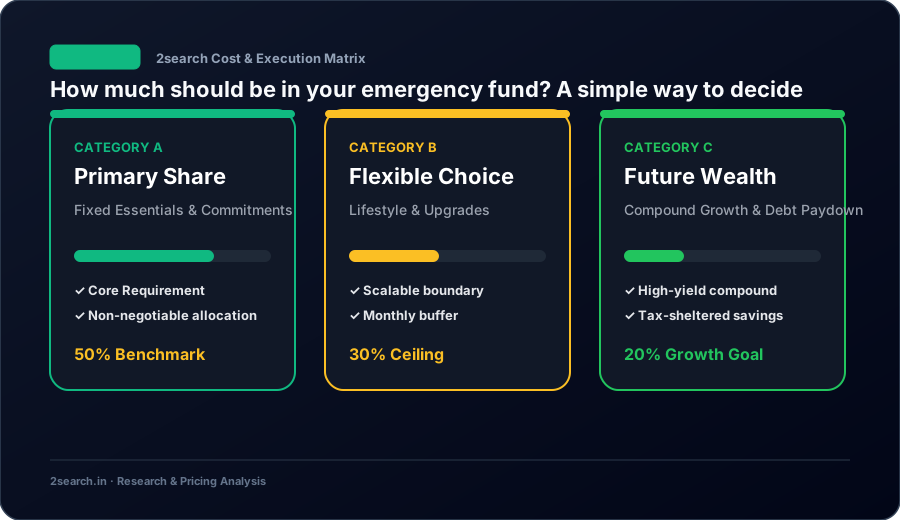
The 50/30/20 budget rule can help you find the money: much of the "20%" can go to the emergency fund until it's full.
Emergency fund vs paying off debt
- High-interest debt (credit cards): build a small fund first (one month or $1,000), then attack the debt hard, then finish the full fund.
- Low-interest debt (home loan): build the full emergency fund first.
Without any buffer, the next surprise goes straight back onto the card.
What counts as an emergency?
Yes:
- Job loss or a big drop in income
- Medical or dental bills not covered by insurance
- Urgent home or car repairs needed to live or work
- Emergency travel for family
No:
- Holidays, sales, gadgets, weddings you knew about
- Planned expenses like school fees or insurance renewals — save for these in a separate "sinking fund"
After you use it
Refill it as soon as possible. Treat the refill like a bill until you're back to your target.
Review it once a year
Your number changes when your rent, family size or job changes. Check it every year — and after any big life event.
Tip: An emergency fund covers the short term; for the long term, check how much life insurance you need (US) or how much term cover you need (India).
Frequently asked questions
Is 3 months or 6 months better for an emergency fund?
Three months suits stable, dual-income households. Six months or more is safer for single earners, families and the self-employed.
Should my emergency fund be based on income or expenses?
Essential expenses. You don't need to replace your whole salary — just cover what you must pay.
Where should I keep my emergency fund?
Somewhere safe and fast: a high-yield savings account in the US, or a savings account with a sweep FD or liquid fund in India.
Can I invest my emergency fund?
Only in very low-risk, easy-to-access options. Avoid stocks and equity funds for this money.
Is a credit card an emergency fund?
No. It's borrowing at high interest. It can help in a pinch, but it isn't savings.
How much emergency fund do I need as a freelancer?
Usually 6–12 months of essential expenses, because income can stop suddenly.
Should I keep cash at home?
A small amount for power or network outages is fine. Keep the rest in a bank.