- Home
- Articles
- Heating & cooling
- AC replacement cost in 2026: prices by size, SEER2 and brand
AC replacement cost in 2026: prices by size, SEER2 and brand
A new central AC costs $2,500–$7,500 installed; a 3-ton system runs about $3,000–$6,500. Prices by tonnage and SEER2, the refrigerant change, repair-or-replace rule and ways to save.
On this page
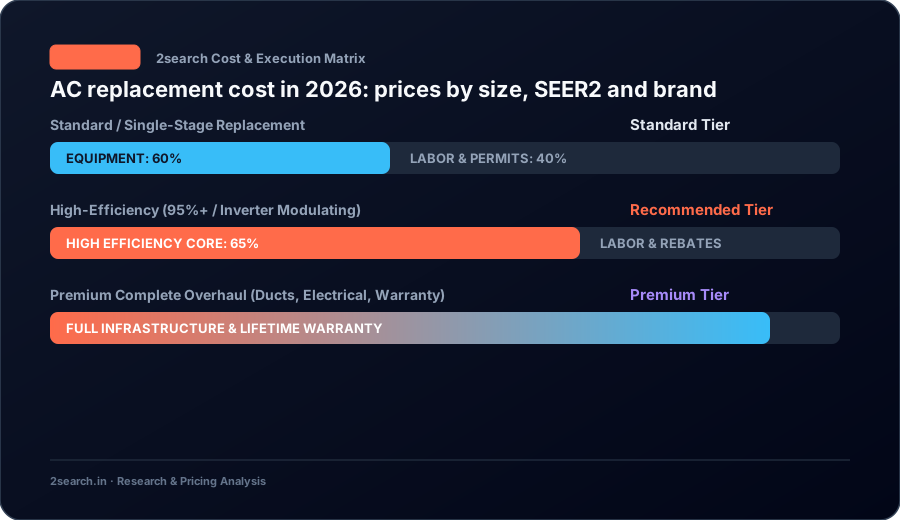
Quick answer: A new central air conditioner usually costs $2,500–$7,500 installed, depending on size, efficiency and how complex the job is. A 3-ton system for a 1,600–1,900 sq ft home typically runs $3,000–$6,500. High-efficiency (20+ SEER2) or complicated installs can reach $10,000–$12,000. Labor is often 40–60% of the bill. Since 2025–2026, new systems use R-454B or R-32 refrigerant, which has nudged prices up.
Key takeaways
- Size matters more than brand: get a Manual J load calculation, not a rule-of-thumb guess.
- Federal minimum efficiency is 13.4 SEER2 (North) and 14.3 SEER2 (South) for most home systems.
- The federal 25C tax credit for AC and heat pumps ended after 2025 — look for utility and state rebates instead.
- A heat pump costs a bit more but replaces both AC and furnace in many climates.
- If your AC is 10–15+ years old and needs a big repair, replacement usually makes more sense.
When your AC dies in July, you don't have much time to shop. This guide gives you realistic 2026 prices by size and efficiency, explains what drives the quote, how to tell repair from replace, and how to avoid paying too much.
AC replacement cost by size
| System size | Typical home size | Installed cost (mid-efficiency) |
|---|---|---|
| 1.5–2 tons | 600–1,200 sq ft | $2,500–$5,000 |
| 2.5 tons | 1,200–1,500 sq ft | $2,800–$5,800 |
| 3 tons | 1,500–1,900 sq ft | $3,000–$6,500 |
| 3.5–4 tons | 1,900–2,500 sq ft | $3,800–$7,500 |
| 5 tons | 2,500–3,300 sq ft | $4,500–$8,500 |
These figures assume existing ductwork in good condition and a like-for-like swap. Hot, humid climates, older homes and poor insulation can need a bigger size.
Cost by efficiency (SEER2)
| Efficiency | Typical installed cost (3-ton) | Who it suits |
|---|---|---|
| 13.4–15 SEER2 (minimum) | $3,000–$5,000 | Mild summers, tight budgets |
| 16–17 SEER2 | $4,500–$7,000 | Most homes in hot regions |
| 18–20+ SEER2 (variable-speed) | $7,000–$12,000 | Very hot climates, long run hours, comfort-focused |
Example: Upgrading from a 14 SEER2 to a 17 SEER2 system cuts cooling electricity by roughly 18%. If you spend $1,000 a year on cooling, that's about $180 a year — so a $2,000 price difference pays back in about 11 years. In Phoenix or Houston, with double the cooling, payback is far quicker.
SEER2 replaced SEER in 2023 with tougher testing; a SEER2 number is a bit lower than the old SEER for the same unit.
What's included — and what adds cost
A standard quote usually covers:
- New outdoor condenser and matching indoor evaporator coil
- Refrigerant line set flush or replacement
- New thermostat (often)
- Electrical disconnect and whip, pad, permits, and old unit removal
Extra costs you might see:
| Item | Typical cost |
|---|---|
| New furnace or air handler (if not compatible) | $2,000–$6,000 |
| Ductwork repair or sealing | $500–$2,500 |
| New ductwork (whole home) | $3,000–$10,000+ |
| Electrical panel upgrade | $1,500–$4,000 |
| Smart thermostat | $150–$350 |
| Line set replacement | $300–$1,000 |
| Crane or difficult access (rooftop/attic) | $300–$1,500 |
The refrigerant change (R-410A → R-454B / R-32)
- From 1 January 2025, manufacturers stopped making new R-410A home AC systems, and by 2026 new installations use low-GWP A2L refrigerants — mainly R-454B and R-32.
- These systems need updated components and installer training, which pushed equipment prices up.
- Your existing R-410A system can still be repaired, but R-410A refrigerant is getting more expensive as supply shrinks. A big leak on an old R-410A unit is a strong reason to replace.
- You usually can't just swap the outdoor unit — the indoor coil must match the new refrigerant.
Repair or replace?
Use the "$5,000 rule" as a quick guide: age of unit × repair cost. If the result is more than $5,000, replacing usually makes more sense.
Example: A 12-year-old AC needs a $900 compressor repair → 12 × 900 = $10,800. Replace. A 5-year-old unit needs a $400 capacitor and fan motor → 5 × 400 = $2,000. Repair.
Replace when:
- The system is 12–15+ years old.
- It needs a compressor or coil replacement out of warranty.
- It has repeated refrigerant leaks.
- Bills keep rising and some rooms never cool.
- You're replacing the furnace anyway — consider a matched system or a heat pump.
Repair when:
- It's under 10 years old and the fix is minor (capacitor, contactor, fan motor, drain line).
- It's still under warranty.
AC vs heat pump
| Does | Cooling only | Cooling and heating |
|---|---|---|
| Installed cost (3-ton) | $3,000–$6,500 | $4,500–$10,000 |
| Best for | Homes with a newer gas furnace | Mild-to-cold climates; replacing both AC and furnace |
| Running cost | Similar for cooling | Heating can be much cheaper than electric resistance or propane |
Modern cold-climate heat pumps heat well down to around -5°F to -15°F. See heat pump vs furnace.
Brands: does it matter?
Most brands are built by a handful of manufacturers, and installation quality matters more than the logo. Rough price tiers:
| Tier | Example brands |
|---|---|
| Premium | Carrier Infinity, Trane, Lennox Signature, American Standard |
| Mid-range | Rheem, Ruud, Daikin, Bryant, York, Mitsubishi (ducted) |
| Value | Goodman, Amana, Payne, Heil, Tempstar |
Choose the contractor first, then the brand they install and service well. Look for 10-year parts warranties (with registration) and a labor warranty of at least 1–2 years.
How to save money
- Get 3 quotes with the same size and SEER2 so you can compare fairly.
- Ask for a Manual J load calculation — an oversized AC costs more and short-cycles.
- Check utility rebates and state programmes — many offer $300–$2,000+ for high-efficiency systems or heat pumps.
- Replace in spring or fall when contractors are less busy.
- Ask about financing at 0% (read the terms carefully).
- Seal ducts and add attic insulation — it can let you buy a smaller unit. See attic insulation cost.
Questions to ask contractors
- Did you do a Manual J load calculation? Can I see it?
- Is the indoor coil included and matched (AHRI-certified match)?
- What refrigerant does it use?
- What's the parts and labor warranty? Who registers it?
- Are permits, line set, thermostat, disposal included?
- How long will the install take?
- Are you licensed and insured? (Check your state's licensing board.)
Signs your AC is failing
- Warm air or weak airflow
- Ice on the refrigerant lines or coil
- Constant short-cycling (turning on and off)
- Loud buzzing, grinding or clanking
- Water leaks around the indoor unit
- Rising energy bills with no change in use
- High indoor humidity even when running
Frequently asked questions
How much does a new AC unit cost in 2026?
Most homeowners pay $2,500–$7,500 installed. A 3-ton system usually costs $3,000–$6,500.
Is there a federal tax credit for a new AC in 2026?
The federal 25C energy efficiency credit ended for systems installed after December 31, 2025. Check your utility and state for rebates.
How long does an AC last?
Typically 12–17 years with regular maintenance; less in very hot, coastal or dusty areas.
Can I replace just the outdoor unit?
Usually not with today's refrigerants — the indoor coil needs to match the new system for efficiency, warranty and refrigerant compatibility.
What size AC do I need?
A rough guide is 1 ton per 500–600 sq ft, but a Manual J load calculation is the right way to size it.
Should I replace my furnace and AC together?
If both are over 12–15 years old, replacing them together can save on labor and ensures a matched system. A heat pump may replace both.
How long does AC installation take?
Usually one day for a straightforward replacement; longer if ductwork or electrical work is needed.