- Home
- Articles
- Heating & cooling
- Whole-house generator cost in 2026: standby prices by size
Whole-house generator cost in 2026: standby prices by size
A standby generator costs $6,000–$11,000 installed; a 22 kW unit runs about $9,500–$10,000 all-in. Sizes, fuel costs, transfer switches, portable and battery alternatives, upkeep.
On this page
Quick answer: A natural-gas or propane standby generator typically costs $6,000–$11,000 installed. A 22 kW unit — enough to run most average homes, often including central AC — usually lands near $9,500–$10,000 all-in, and large or complex systems can reach $15,000–$24,000. Plan on $200–$600 a year for maintenance. A portable generator with an interlock kit is a cheaper partial-home option at roughly $1,500–$3,500 total.
Key takeaways
- Size the generator from your must-run loads, especially central AC, well pumps and electric heat.
- The automatic transfer switch is essential for safety and is often $1,200–$1,600 installed.
- Natural gas is cheapest to run and never runs out; propane needs a tank sized for multi-day outages.
- Load management modules let a smaller generator run a bigger home.
- Never run a portable generator indoors or in a garage — carbon monoxide kills.
Longer and more frequent power outages — from storms, heat waves and wildfires — have made standby generators a common home upgrade. This guide breaks down 2026 costs, helps you choose the right size, explains fuel choices, and compares generators with portable units and home batteries.
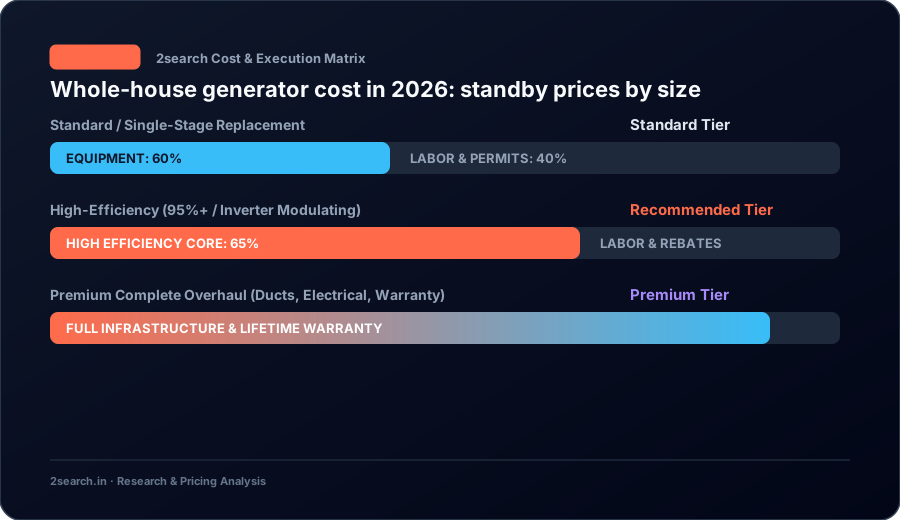
Standby generator cost by size
| Generator size | What it typically powers | Installed cost |
|---|---|---|
| 10–14 kW | Essentials: fridge, furnace fan, sump pump, lights, outlets, internet | $6,000–$9,000 |
| 17–20 kW | Most of a typical home; smaller central AC with load management | $7,000–$11,000 |
| 22–26 kW | Whole home for many 2,000–3,000 sq ft houses, including central AC | $9,500–$14,000 |
| 30–48 kW (liquid-cooled) | Large homes, multiple ACs, electric heat | $15,000–$24,000+ |
What's in the price
| Item | Typical cost |
|---|---|
| Generator unit (22 kW air-cooled) | ~$5,500–$7,000 |
| Automatic transfer switch (ATS) | $1,200–$1,600 installed |
| Gas line from meter or propane tank | $400–$1,500 |
| Electrical work and wiring | $500–$2,000 |
| Concrete or composite pad | $150–$400 |
| Permits and inspection | $80–$450 |
| Gas meter upgrade (if needed) | $0–$1,000 (often free from the utility, but can take weeks) |
| Propane tank (if no natural gas) | $500–$3,000+ for 250–500 gallon tanks, or leased |
| Load management modules | $200–$600 each |
Prices are higher where electrical panels need upgrading, the generator must sit far from the house, or local codes need extra work.
What size generator do you need?
- List must-run loads and their running watts. Big ones to check:
| Load | Running watts (approx.) | Starting watts |
|---|---|---|
| Central AC (3-ton) | 3,500–4,500 | 7,000–10,000+ |
| Heat pump (3-ton) | 3,500–5,000 | Higher (soft starters help) |
| Furnace blower | 600–1,000 | 1,200–2,000 |
| Well pump (1 hp) | 1,000–1,500 | 2,000–3,000 |
| Refrigerator | 150–250 | 700–1,200 |
| Sump pump (½ hp) | 800–1,000 | 1,500–2,500 |
| Electric water heater | 4,500 | 4,500 |
| Electric range | 3,000–8,000 | — |
| Lights, TV, internet, outlets | 1,000–2,000 | — |
- Add running watts, plus the biggest starting surge.
- Add 10–20% headroom.
Example: A 2,200 sq ft gas-heated home with a 3-ton AC: AC 4,000 W + furnace 800 W + fridge 200 W + sump 900 W + lights/outlets 2,000 W ≈ 7,900 W running. AC start adds ~5,000 W surge → ~13,000 W peak. With headroom and future loads, a 17–22 kW generator is a comfortable fit.
Tip: A soft-start kit on your AC ($200–$400) cuts its starting surge, often letting you buy a smaller generator.
Many installers do a load calculation based on your panel and past electric bills — ask for it.
Natural gas vs propane vs diesel
| Fuel | Pros | Cons | Running cost (22 kW at half load, rough) |
|---|---|---|---|
| Natural gas | Unlimited supply, cheapest per hour, no tank | Slightly lower output; needs adequate meter size | ~$1.50–$3 an hour |
| Propane | Works anywhere; stores for years | Need a big tank for long outages | ~$5–$9 an hour (about 1.8–2.2 gal/hr) |
| Diesel | Common on very large units | Fuel goes stale; louder; storage rules | Varies |
Example: A 22 kW propane generator at half load burns about 2 gallons an hour. A 5-day outage (120 hours) needs about 240 gallons — a 500-gallon tank (filled to 80%) covers that with some to spare.
Air-cooled vs liquid-cooled
- Air-cooled (most home units up to ~26 kW): cheaper, simpler, louder at full load.
- Liquid-cooled (usually 30 kW+): quieter, longer-lasting, for big homes and long run times; costs more.
Maintenance and running costs
- Annual service: $200–$600 — oil and filter change, spark plugs, battery check, software updates.
- The generator runs a weekly self-test for 5–20 minutes, using a little fuel.
- Replace the battery every 3–5 years.
- With good care, standby generators often last 20–30 years or 3,000+ hours.
Alternatives to a whole-house standby generator
| Option | Total cost | Pros | Cons |
|---|---|---|---|
| Portable generator + interlock kit and inlet | $1,500–$3,500 | Much cheaper; runs selected circuits | Manual setup in storms; refuelling; CO danger if misused |
| Portable inverter generator (extension cords only) | $500–$2,000 | Quiet, cheap | Few appliances; no hardwired circuits |
| Home battery (e.g., 13.5 kWh) | $10,000–$16,000 per battery | Silent, no fuel, works with solar | Limited run time for AC and heat; multi-day outages need solar |
| Battery + solar | $25,000–$45,000+ | Recharges daily | Highest cost; winter output lower |
Compare with solar panel cost if you're considering a battery.
How to choose an installer
- Use a factory-authorised dealer for warranty support.
- Ask for a load calculation, permit handling and a written warranty (5–10 years is common).
- Confirm the placement meets code — usually at least 5 feet from windows, doors and vents, and specific distances from gas meters.
- Ask about maintenance plans and response times after storms.
Safety essentials
- Never connect a generator to your home without a transfer switch or interlock — backfeeding can kill utility workers.
- Install carbon monoxide alarms on every level.
- Keep portable generators 20+ feet from the house, with the exhaust pointing away.
- Keep the area around a standby unit clear of snow, plants and debris.
Frequently asked questions
How much does a whole-house generator cost?
Usually $6,000–$11,000 installed for standard sizes; a 22 kW unit is often about $9,500–$10,000 all-in.
What size generator do I need to run my whole house?
Many 2,000–3,000 sq ft homes need 20–26 kW to run everything including central AC. A load calculation gives the right answer.
How long can a standby generator run?
On natural gas, as long as gas is supplied (with breaks for oil checks during very long outages). On propane, until the tank runs low.
Does a generator add value to a home?
It can — buyers in storm-prone areas often value backup power. Exact value varies by market.
Is a portable generator enough?
For essentials, often yes, with an interlock kit. For whole-house automatic backup, choose a standby unit.
How loud is a standby generator?
Many air-cooled units run around 60–70 dB at a few metres — similar to a conversation or a loud AC unit. Weekly tests often run in a quieter mode.
Do I need a permit to install a generator?
Usually yes — electrical, gas and sometimes zoning permits. Licensed installers typically handle them.